Can AI Rewild Us?
We’ve raced ahead for millennia—maybe it’s time to circle back.

I recently went to lunch with an old work friend who has left the corporate world for what I would call a half early retirement. She is passionate about the FIRE movement (Financial Independence Early Retirement). She loves making careful, calculated decisions with her money and while she was working on my team she got very interested in real estate investing. Passion drives learning like nothing else - she has spent countless hours learning the ropes, techniques, loopholes, and strategies to investing well and building passive income with the hopes of eventually getting to a place where her spouse can also clock out of the rat race for good. Even now, they are spending six months of the year in Baja California in a camper while they rent out their house. Alongside their work they are focused on things like hiking, cooking, playing with their dogs, and nurturing social connections (I should mention that this couple chose not to have kids, so that simplifies things a little).
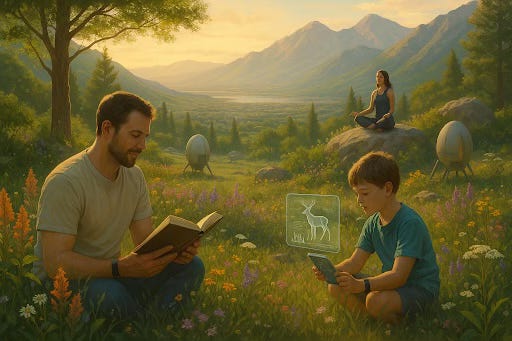
What strikes me about this situation is how radical this lifestyle is, when it is actually much closer to how our ancestors evolved for millions of years. For most of our existence, we have lived more in-the-moment. Hunter-gatherers roamed to find food for that day, guided by natural rhythms and immediate needs. There were no calendars packed with meetings, no endless notifications vying for attention. Life was physically demanding but deeply connected—to the land, to others, and to the present.
Jared Diamond has argued that the shift from hunting and gathering to agriculture around 10,000 years ago, along with its many benefits, marked a decline in human health, equality, and quality of life. In the last several decades, the shift to a sedentary, screen-based life has been a physical and mental health catastrophe - altering attention, sleep patterns, several dimensions of health, and social interactions.
In “Economic Possibilities for our Grandchildren” (1930), John Maynard Keynes predicted that by the early 21st century, technological progress and capital accumulation would enable us to solve the "economic problem"—that is, the struggle for basic survival—and work about 2–3 hours per day, while still enjoying a comfortable standard of living. We’d then be faced with the problem of figuring out how to spend all that free time. But we have always found new ways to work - solutions create new problems that need new solutions, on and on.
The question of “how will we find meaning and purpose (and food) when the machines do everything for us?” is a very important one, but given how many times we’ve been wrong about this in the past, I’m skeptical. I’ll believe it when we start to see it. A more practical problem to address, given that we continue to find more and more work for ourselves, is what we want work, and our moment-to-moment experience in it, to look like going forward?
This brings us back to human flourishing and what we know is good for us. In Christopher Ryan’s “Civilized to Death”, he talks about seeing badly maintained zoos in certain parts of the world where the animals don’t have enough space or natural activities to thrive. Contrast that with something like the San Diego zoo, while still a zoo, it’s a much better approximation to how that animal was meant to live. The difference is obvious in how the animals look and act.
Our problem at this moment in history is that we’ve built a pretty bad zoo for ourselves. We need to build a better one. As we design our AI-powered future, what if we aimed not just for efficiency, but to incorporate several things that we know make us feel better?
We live with constant stress and anxiety that don’t serve us. We neglect social connections to our detriment. We see silence and reflection as a waste of time. We often don’t value activities that don’t move the needle in some immediate, measurable way - like talking to your 3 year old about dinosaurs - when many of those activities are truly valuable to shaping happy human lives.
Maybe our current way of working was just a moment in history. Maybe the interfaces we work on will change drastically. If many knowledge workers are going to be overseeing a team of agents, can I do that while I’m on a walk rather than writing updates in Jira?
A friend of mine recently told me that his start-up spent 2 weeks on a problem that he thinks they could have solved in 10 hours if they were all in the same room. Whiteboard virtually is just not the same. In the future can we make virtual spaces that feel indistinguishable from reality so that we can communicate and bond in more rich ways?
Another friend told me that his side-turned-fulltime gig of driving for Uber is the most satisfying and fun job he’s ever had. As AI becomes more prevalent, can we carve out spaces for conversation and economically value work that requires human interaction?
I invite you to join me in this revolution and carve time out in your life for four things:
Exercise - get some!
Sunlight - absorb some!
Social connection serving others without an agenda
Slow down and see the value in those hard-to-measure tasks
Because maybe the real promise of AI isn’t that it will outthink us—but that it might just help us remember what it means to be human.
Exponential tech, ancestral truths—maybe we need both.